Procurement processes often reward presentation quality over strategic alignment. That’s becoming a bigger problem in destination marketing.
Destination marketing organizations spend enormous amounts of time building agency RFPs designed to create structure, transparency, and accountability. Those goals matter. But increasingly, the traditional RFP process may be unintentionally selecting for the wrong things.
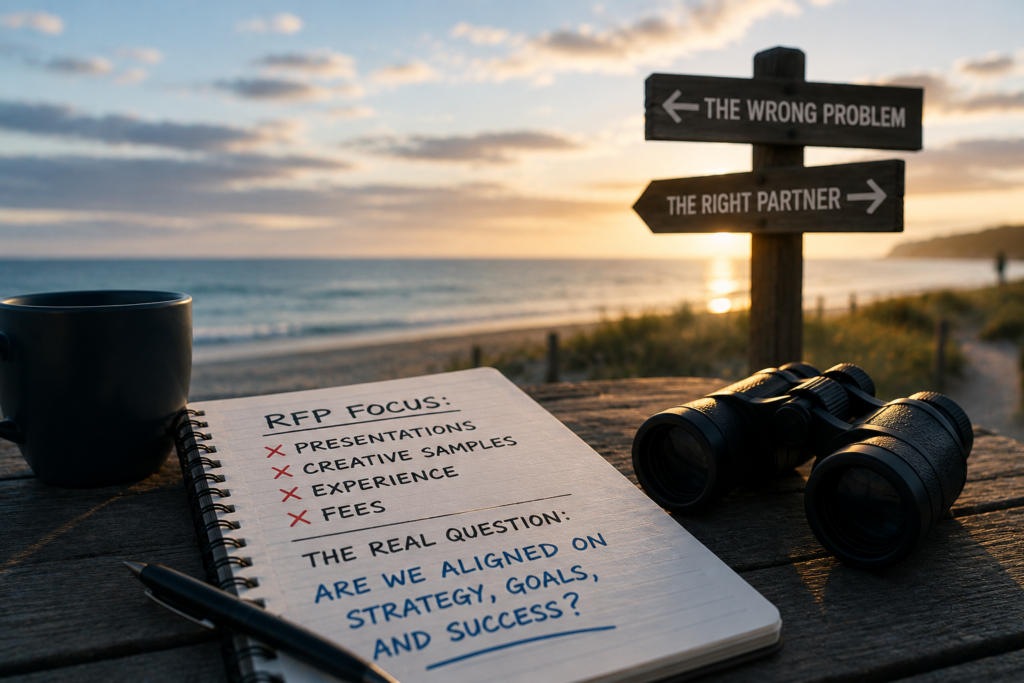
Most RFPs are built to evaluate agencies. Very few are designed to evaluate alignment.
As a result, destinations often find themselves asking questions like:
- Who has the strongest creative?
- Who has the most impressive client roster?
- Who offers the lowest fees?
- Who delivered the best presentation?
These are reasonable considerations. But they may not be the factors that ultimately determine success.
The reality is that many destination marketing partnerships don’t fail because of poor creative, ineffective media placement, or a lack of expertise. They struggle because the destination and the agency never fully aligned around expectations, priorities, decision-making processes, or definitions of success.
In other words, they begin on parallel tracks.
The Best Agency Isn’t Always the Best Partner
The destination marketing industry has become increasingly specialized. A typical DMO may work with a creative agency, media buying agency, public relations firm, website developer, research provider, attribution platform, social media contractor, and a host of local stakeholders.
Each partner may be highly capable. Yet many organizations still experience frustration.
Why?
Because capability and alignment are not the same thing.
An agency can have award-winning creative and still be the wrong fit for a destination. A media partner can produce strong results but struggle to communicate effectively with leadership. A PR firm can generate impressive coverage but fail to support broader organizational goals.
The challenge is rarely talent.
The challenge is ensuring everyone is working toward the same destination.
The Missing Question
Most RFPs spend significant time asking agencies to explain who they are and what they do.
Far fewer ask:
How will you integrate with our organization?
How will you collaborate with our board?
How will you communicate performance?
How will you respond when priorities change?
How will you help align multiple stakeholders with competing expectations?
How will you support implementation of a strategic plan rather than simply executing a scope of work?
These questions are often harder to answer than media strategies or creative concepts. They are also frequently more important.
The strongest partnerships are built on trust, communication, and alignment—not just deliverables.
The Cost of Misalignment
Misalignment is expensive.
It creates unnecessary meetings, conflicting priorities, reporting confusion, strained relationships, and ultimately diminished performance.
Perhaps most importantly, it distracts organizations from their actual mission.
Destination leaders should be focused on building stronger visitor economies, supporting local businesses, and advancing community priorities. Instead, many find themselves acting as translators between agencies, boards, elected officials, and stakeholders.
The result is friction where there should be momentum.
Rethinking the Role of the RFP
This doesn’t mean RFPs are broken.
It means their purpose may need to evolve.
The most effective procurement processes are not simply selecting vendors. They are identifying partners capable of aligning with the destination’s vision, culture, governance structure, and long-term objectives.
That requires a different set of questions.
It requires evaluating how partners think, communicate, collaborate, and adapt—not just what they create.
Most importantly, it requires recognizing that destination marketing success is rarely the result of a single agency. It is the result of many people moving in the same direction.
Closing the Gap
At Rail3, we believe the gap between strategy and execution is often where destination marketing organizations lose momentum.
The right agency can help close that gap.
The wrong procurement process can widen it.
As destinations continue to navigate increasing complexity, stronger accountability requirements, and growing stakeholder expectations, the question is no longer simply:
“Who is the best agency?”
The better question may be:
“Who is the best partner for where we’re trying to go?”